
Making Global Service-Learning Work for the Communities It Serves
Research on a short-term service-learning course in Costa Rica suggests that partner-led planning, attention to the power dynamics of language, and reflection that continues after students return home can shape how they learn to work with communities different from their own.
01 — Research Summary
Introduction
colleges and universities offer short-term study abroad courses pairing classroom instruction with community service in host countries. These programs, often called global service-learning (GSL), can risk reproducing “charity logics,” or positioning students as helpers or saviors and the host communities as recipients, when preparation, reflection, and accountability to partners are underdeveloped.
For this edition, NCA Amplified is highlighting a study published in Communication Education by Mark J. Congdon and Annie Johnson of Sacred Heart University. In this qualitative project, the authors led two separate cohorts of undergraduate students through an intentionally designed short-term GSL course to Limón, Costa Rica.
Students described insights about listening to local partners, the power dynamics of language, and, in some cases, the effects of systemic racial inequality on local life. Some students continued to apply concepts they had learned in the GSL course 18 months later.
Bringing Critical Communication Pedagogy Abroad
The course described in this study was designed with Critical Communication Pedagogy (CCP) in mind, an approach described by Deanna Fassett and John Warren that treats education as a site for social justice work in which communication shapes identity, culture, and power. CCP challenges educators to help students learn with, rather than about, people across differences. In their 2007 book, Critical Communication Pedagogy, Fassett and Warren write that CCP “is ultimately about the journey, rarely the destination,” a fitting frame for a research study that followed students well beyond the initial trip itself.
Sacred Heart University’s Department of Communication and Media and Office of Community Engagement co-designed the course with partners at Tecnológico de Costa Rica (TEC) in Limón, Costa Rica. Sacred Heart’s engagement office managed logistics and partner communication; the academic department led the coursework; and TEC faculty and staff served as co-educators, contributing to agendas, site visits, and local community-articulated priorities.
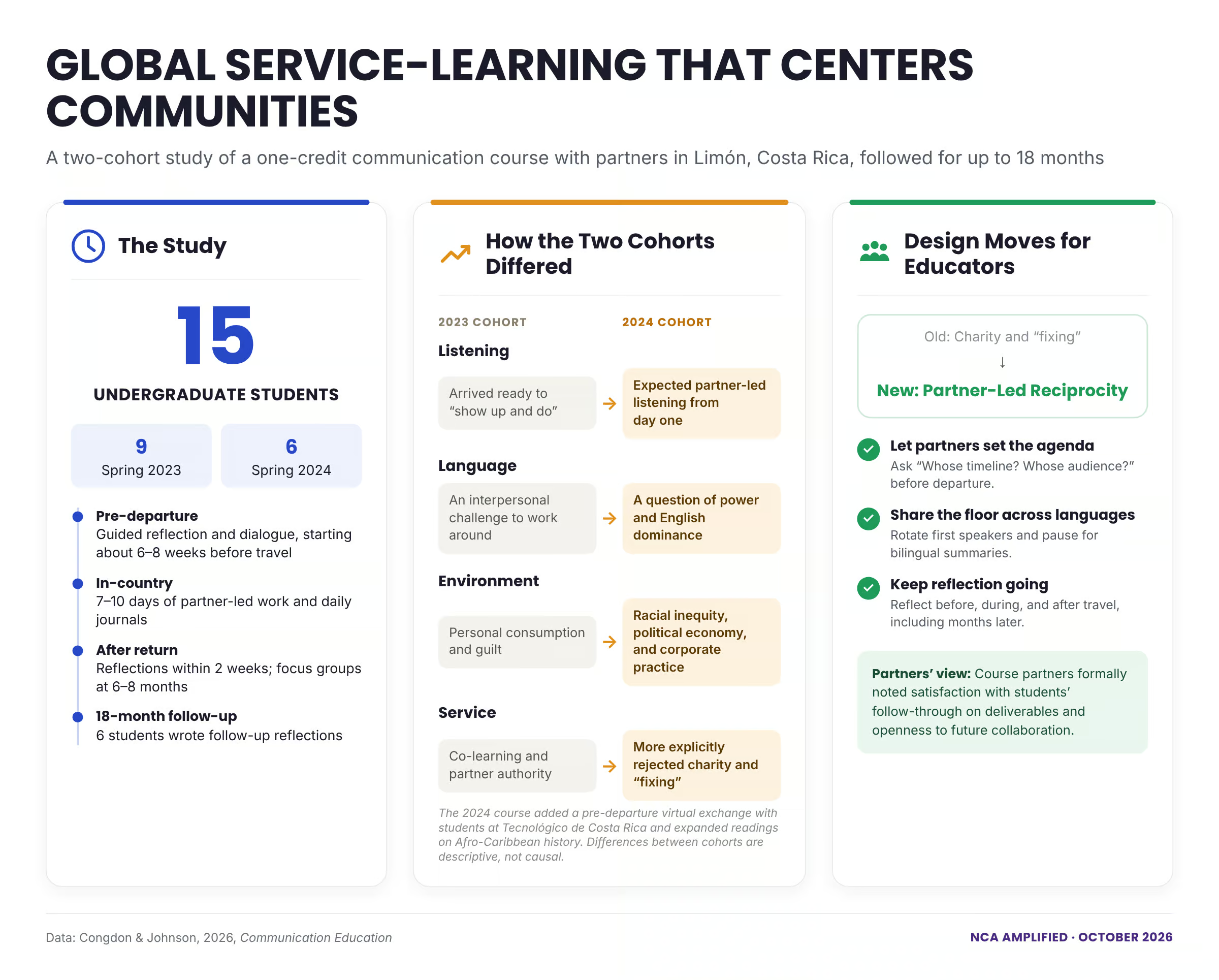
The researchers followed nine students in 2023 and six in 2024 from pre-departure through seven to 10 days in Limón and their return home. Materials and methods used in the qualitative analysis included journals, focus groups, instructor and partner notes, multimodal student reflections, and 18-month follow-up reflections from some of the students.
Students Described Listening First and Naming Power Dynamics
Both the course and the analysis were organized around four CCP concepts: critical dialogue, reflexivity and positionality, intercultural competence, and ethical engagement.
Several students in the 2023 group remembered showing up ready to help and to complete the assigned work. In 2024, the instructors added a virtual exchange with TEC students and more readings on Afro-Caribbean history to the pre-departure work. That year’s students more often described listening first as something expected of them from the start.What students wrote also changed over time. After the 2023 trip, their reflections dealt mostly with their own privilege and self-awareness. In the 2024 cohort’s reflections and the 2023 cohort’s 18-month follow-up, several students went further by linking what they saw in Limón to history, race, relations of power, and other structural issues. Writing about how much Limón depends on tourism and foreign businesses, one 2024 student put it this way: “It felt like colonialism never really ended; it just changed forms.”
Language was one place where these structural connections showed up especially clearly. For the 2023 group, language differences were mostly an interpersonal hurdle. More of the 2024 students saw English itself as a source of power in the room. “Language justice is a real issue; even though we were the visitors, our ability to speak English often dominated the space,” one 2024 student wrote. Students in 2024 also described taking turns on who spoke first and stopping for bilingual summaries. Partner notes expressed appreciation for students who paused for translation and created a “shared rhythm.”
The authors propose language justice, which they describe as attention to who gets to speak and whose pace sets the conversation, as a “hinge” connecting intercultural communication to ethical engagement. Drawing on critical service-learning research, they set ethical engagement apart from paternalistic “charity” models that treat students as providers and communities as recipients. Instead, this GSL design encouraged students to emphasize shared authority and responsiveness to needs that the community itself identifies.
From Charity to Accountable Partnership
Across both groups, several students described co-learning with partners in the host community, with the 2024 cohort more explicitly rejecting charity lenses. One 2024 student said she now recognized that communities are not “problems to fix” but partners “with knowledge and agency.” For educators, Congdon told NCA, reflection “has to go further than ‘What did this experience mean to me?’” The authors frame the experience as a direct collaboration and partnership with the hosts.
The authors’ advice for instructors is concrete: name course outcomes in CCP terms, share partners’ priorities with students before they leave, and drop generic “service” in favor of “concrete, partner-vetted communication tasks.” For colleges, the authors suggest institutionalizing support “for ethically accountable GSL rather than leaving those conditions to individual instructors.” One way to do that is to house courses in a community engagement office while keeping academic oversight. The authors also suggest establishing formal, paid channels for host-country community partners to provide feedback that shapes the course. Paying careful attention to course design before the experience starts is important because, as Congdon also noted to the NCA, “Short-term programs have little time to correct a weak design once students arrive.”
Conclusion
While this study cannot prove cause and effect, it suggests that, in designing and administering GSL courses, giving local partners authority over the work, treating language as a question of power, and sustaining structured reflection can create conditions in which CCP commitments show up in how students communicate about and learn from the experience. The authors call for future studies with larger, more demographically diverse samples and a greater role for local partners in defining outcomes and interpreting results. That emphasis on listening echoes a hope Fassett and Warren express near the end of their book: that “we all build a better tomorrow by listening to each other and imagining our futures together.”
02 — Key Applications
- In service-learning scenarios (study abroad or local), emphasize partner priorities. Have students ask questions such as “whose timeline and whose audience?”
- Give students a specific job that partners have signed off on, instead of a vague “service” assignment.
- If a group speaks more than one language, practice taking turns on who speaks first and stop for quick summaries in each language. Accept a slower pace so more voices are heard.
- Build in critical reflections before, during, and well after the experience.
- Allow students to choose to reflect in a way that serves them best: whether a paper, a podcast, a poem, a slide deck, or something else.
- These practices can be transferred to internship / work-study programs as well.
- Encourage and support student civic engagement as part of their experiences after a program ends.
- Advocate for and design funding specifically supporting the staff time, stipends for community partners, resources such as local texts, and other tools needed to help global service learning and similar programs succeed.
- When allocating funding for these programs, include the perspective and needs of potential community partners.
- After programs end, ask community partners whether the work met their priorities, and use that feedback to shape future funding calls.
- Advocate for institutional structures allowing these programs to run jointly through academic departments and community engagement offices.
- Incentivize academic research like the study described above to encourage additional knowledge and capacity building, leading to the strengthening and growth of service-learning opportunities for students.
- Support funding sustaining long-term institutional partnerships rather than one-time trips.
- In addition to supporting academic research from universities, work closely with institutions that exist to help amplify study abroad and global service learning (NAFSA, IIE, Campus Compact, Fulbright Program, etc.).
- Stories about student service trips and service-learning in general should include host communities and local partners’ perspectives, not only the students and administrators.
- Be careful with language that casts host communities as people who need saving or charity. In this study, community partners were co-educators who set priorities and shaped the work.
- Avoid promotional study abroad (and similar programs) materials that frame visitors as saviors. Show partners as co-educators and decision-makers.
- Budget for interpretation and bilingual materials, and ask partners for feedback when creating content to promote programs to students.
- Avoid paternalistic and “savior” language in campaigns promoting service learning to students.
- If your organization hosts student groups, work to ensure the perspective of your organization and stakeholders is prioritized.
- Local groups, especially those working with multilingual communities, can offer students volunteer roles in language access, public listening, or other communication or civic work that the organization defines.
03 — Citation and Link to Study
Congdon, M. J., & Johnson, A. (2026). Rooted in reflection, branching toward justice: Critical communication pedagogy in short-term global service-learning. Communication Education. Advance online publication. https://doi.org/10.1080/03634523.2026.2723093
Fassett, D. L., & Warren, J. T. (2007). Critical communication pedagogy. Sage.

04 — About the Authors


Research shows people’s natural urge to “mill” additional information and prior experience and knowledge with hazards dictates how communities respond to alerts about imminent danger.