This document is not intended to be used or referenced by any other parties or individuals who are not NCA journal authors, issue editors, or editors.
The goal is to ensure a fair, consistent, transparent, and IDEA-informed process that reflects the National Communication Association’s commitment to inclusion, diversity, equity, and access.
This best practice guidance aligns directly with the following principles of the NCA Strategic Plan 2023-2027 and the 2021 IDEA Strategic Plan
- GOAL 4: CULTIVATE A THRIVING AND RESPONSIVE ORGANIZATION
- 4.2 Foster reflexive governance and administrative practices and informed decision-making
- IDEA GOAL 3: EQUIP ALL NCA LEADERS AND MEMBERS TO CARRY OUT IDEA VISION AND INITIATIVES WITHIN AND BEYOND NCA.
- 3.2 Increase and promote the importance of IDEA strategic planning across the discipline.
Policy Principles
- When a disagreement arises, editors should request written statements from all named authors and any individual seeking addition or removal from the author list, while making reasonable efforts to ensure each party has an equitable opportunity to respond.
- Changes to authorship require written agreement from all authors.
- If agreement cannot be reached, the matter should be referred to the institution or institutions where the work was conducted for review and resolution, only with the consent of the author.
- Editors may pause peer review, revision, acceptance, or publication until the disagreement is resolved sufficiently to protect the integrity of the record and the fairness of the editorial process.
Author Disagreements: Who Authors Should Contact
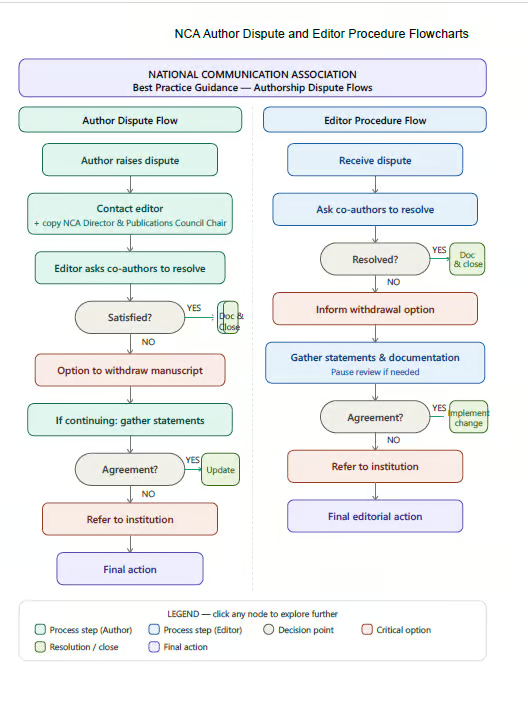
- Authors should email the journal editor directly, copy the Director of Research, Publications, and Professional Advancement of NCA, and the Chair of the Publications Council to raise a disagreement regarding authorship, author order, contributions, acknowledgments, or a request to add, remove, or reorder authors.
- Authors must include the manuscript title, the manuscript number (if available), a brief description of the disagreement or disagreement, and any relevant supporting documentation.
- Editors should keep a clear written record of all communications, statements, and institutional responses related to the disagreement.
- Possible outcomes include, but are not limited to, no change to authorship, correction of the author list or order upon written agreement or institutional determination, revision of acknowledgments, rejection or suspension of a submission, or post-publication correction or other ethics action as needed.
- This policy should be read together with the Taylor and Francis journal’s authorship criteria and publication ethics procedures, acknowledgments, or take other publication ethics action as appropriate.
Who Editors Should Reach Out To
- Corresponding author: First point of contact for clarification and collection of author confirmations.
- All listed co-authors: To confirm contributions, consent, and the proposed author list or changes.
- Any individual claiming authorship or contesting authorship: To obtain a written statement of their claimed contribution and requested remedy.
- Institutional research integrity officer, dean, department chair, or equivalent official: When the authors cannot reach a unanimous agreement or when the disagreement involves possible misconduct, coercion, or misrepresentation.
- Publisher ethics or legal contact, if applicable: When the case presents unusual legal, reputational, or procedural risk.
Procedure for Editors
- Seek resolution among the co-authors. When a disagreement arises, the editor should ask the co-authors to clarify their positions in writing and to attempt to resolve the issue among themselves. If the author raising the concern is satisfied with the response and the matter is resolved, the editor should document the outcome and close the case.
- If the disagreement remains unresolved, advise on withdrawal. If the author is not satisfied with the response, the editor should explain that Taylor & Francis policy allows for withdrawal of the manuscript prior to publication if disagreements arise, and should document any resulting decision.
- Document and gather information. The editor should record the concern, acknowledge receipt, and obtain written statements from the corresponding author, co-authors, issue editors, and any omitted contributors, along with any relevant supporting documentation.
- Pause review and refer if needed. If the disagreement is not resolved and the manuscript is not withdrawn, the editor may pause review or publication and should refer the matter to the appropriate institutional official or research integrity office for determination.
- Act on the outcome.
- Based on written agreement or institutional findings, the journal may process an authorship change, maintain the current record, or revise
Generative AI Acknowledgment: The flowchart titled National Communication Association Best Practice Guidance for Authorship Disagreement was created in Claude AI using the prompt: Review the procedures for both the author and the editor, and create a visually appealing flowchart of the steps.