2026 NCA National Award Winners
“`html
2026 NCA National Awards
Awards for Outstanding Teaching
Paul Schrodt’s passion for teaching is evident in both the words of his students and his scholarship. Described as an ardent supporter, patient guide and empathetic mentor, Schrodt creates a safe and open environment where students can learn, explore and develop confidence in their abilities. His primary concern is student success, and he is dedicated to helping students become independent, creative individuals. His commitment is also reflected in his willingness to listen to students’ struggles, discoveries, ideas and aspirations. As one student shared, “He encompasses the teacher-scholar model better than anyone I know,” making Schrodt an exemplary recipient of the Ecroyd Award.
Modeling excellence in the community college classroom, Brenda Ahntholz has taught at Ohlone College for more than 25 years. Known for fostering safe and welcoming learning environments, Ahntholz uses an engaged teaching style described by students and peers as “dynamic,” “respectful” and “life-changing.” Through partnerships with two regional jails, she has also taught courses to incarcerated individuals, resulting in more than 60 certificates and degrees. A master teacher and scholar, Ahntholz’s work on praxis-based pedagogy and classroom engagement has impacted not only her students but also countless teacher-scholars nationwide.

Over the course of her career, Candice Thomas-Maddox has demonstrated the sustained excellence, innovation and dedication that define truly distinguished teaching. A gifted communicator, her influence extends far beyond the classroom, shaping students’ lives, careers and understanding of themselves and others. Students consistently describe her teaching as engaging, inspiring, intellectually rigorous and life-changing. Through her commitment to student growth, she helps learners develop confidence, critical-thinking abilities and strong communication skills. Her enduring impact on students and the field of education embodies the spirit and purpose of the Wallace A. Bacon Lifetime Teaching Excellence Award.
Awards for Outstanding Scholarship

Kristina Scharp’s scholarly work reflects an exceptional commitment to family communication scholarship. Her record demonstrates theoretical innovation by developing two theories, methodological contributions including the development of thematic co-occurrence analysis, and publications that have been recognized in textbooks, top journals, book chapters and encyclopedia entries, as well as multiple top paper and research awards. Scharp’s leadership at the regional, national and international disciplinary associations, including her years of service to the Family Communication Division, are noteworthy. Her mentorship to students, public engagement through research translation and overall support for diverse scholarly voices further support her commendable dedicated service. Scharp’s work has and continues to shape family communication scholarship and beyond.

Molina-Guzmán and Valdivia establish a foundational framework for analyzing Latina visibility at the intersections of race, gender, embodiment and media production. Drawing on interdisciplinary conversations about racialized embodiment, the authors identify colonial histories that continue to structure media narratives. Over time, this framework has enabled generations of scholars to extend and refine analyses of Latinidad, media power, belonging and cultural citizenship. Its influence extends beyond Communication to Ethnic and Racial Studies, Sociology, Psychology, Feminist, Media and Gender Studies, among others.
Maldonado’s text interrogates binaries like life and death and extraordinarily provides a theoretical account of collective experience through unique occurrences. Importantly, through autoethnographic and metaphoric incisions, his interrogation of his former undocumented status insists that scholars listen to the words of the “so-called voiceless.” This powerful examination of neoliberal rhetoric in Mexico tempers rhetorical theory and criticism with personal narrative. The entire project pushes communication scholars to understand intellectually and viscerally the rhetoric and life of Mestizaje and Mexico as a whole.

Mai’s essay is well-written, organized and thoughtfully argued. Consistent with the aims of the Cushman Award, the essay examines a population experiencing significant barriers to mental health support and seeks to identify the cultural and interpersonal factors that contribute to these challenges. Its clarity and precision ensure that every element serves a purpose. The essay brings important cultural perspectives to the study of mental health and highlights the need for greater understanding and engagement to better support the Asian American community.

Natalie Fixmer-Oraiz’s scholarship stands out for its intellectual rigor, critical insight and sustained contributions to rhetorical studies. Her work has powerfully illuminated the intersections of rhetoric, gender, sexuality, reproduction and public culture, demonstrating how rhetorical practices shape bodies, identities and political possibilities. Her scholarly impact extends beyond an influential body of research to her generous mentorship, teaching and service to the field. Across her work, Fixmer-Oraiz exemplifies the critical imagination and scholarly excellence that distinguish the very best of rhetorical scholarship. Her contributions make her exceptionally deserving of this recognition.

Kevin A. Johnson and Craig R. Smith’s book “Fear and the First Amendment: Controversial Cases of the Roberts Court” provides a cogent set of rhetorical analyses of the constructions of fear in contemporary Supreme Court cases. Focusing on the affective dimensions of First Amendment freedoms, the authors translate and scrutinize the rhetoric of pivotal Roberts Court rulings. In doing so, Johnson and Smith explain the implications of recent Supreme Court decisions on American civil liberties and the limitations and public perceptions thereof. This compelling work demonstrates in sharp relief the continued importance of scholarship regarding the Freedom of Expression.

With more than 25 years of applied research experience, Stephens has made significant contributions to organizational communication, mobile technologies, artificial intelligence, crisis and disaster communication, infrastructure communication and health communication. Her work helps communities facing extreme weather hazards, including flooding and wildfires, develop effective communication systems and has benefited individuals, workplaces, organizations, communities, states and nations. Stephens currently serves as an Artificial Intelligence Expert for the Department of Homeland Security’s Science Advice and Guidance for Emergencies. Her applied scholarship supporting vulnerable Texas communities exemplifies the impact and excellence honored by the Gerald M. Phillips Award.
In “Naming Breonna Taylor: Revitalizing Black Women’s Memory in Digital Spaces and Urban Landscapes,” Alisa Hardy examines the rhetorical practices that create, contest and sustain Black women’s memory across digital spaces and urban landscapes. Grounded explicitly in rhetorical studies, the dissertation demonstrates how the naming and commemoration of Breonna Taylor become sites of rhetorical intervention and social justice. By bringing together digital spaces and physical landscapes, Hardy makes an important contribution to rhetorical scholarship while illuminating how Black women’s lives, memories and legacies are represented and preserved in contemporary public discourse.
In “Social Media, Surveillance, and Resistance in and Beyond Prison,” Annika Pinch offers the concept of platformed carceral citizenship to encapsulate how incarcerated and/or formerly-incarcerated individuals leverage social media to build community. Important to Pinch’s analysis, these content creators are capacitated, via social media, to deconstruct dominant narratives surrounding criminality and incarceration. Pinch’s dissertation meaningfully contributes to the conversations around representation and agency through a mixed-methods framework that will speak to foci across the Communication discipline. The committee commented on the timeliness and clear care demonstrated throughout this dissertation project and celebrates Pinch’s thorough work.

This dissertation makes an important conceptual contribution to communication and mental health scholarship by challenging idealized understandings of resilience. Boumis moves beyond framing resilience as an individual capacity, instead examining how structural inequities, stigma and communicative barriers shape opportunities to enact resilience. The introduction of disenfranchised resilience offers a compelling framework for understanding how material and discursive inequities constrain resilience. Through a creative methodological approach, the dissertation advances an important and timely perspective with potential applications across diverse communication contexts and populations.
Shiv Ganesh embodies the spirit of the NCA Global Communication Award through an expansive career devoted to understanding collective action, organizing, environmental discourses and processes of social change across national and international contexts. He draws extensively on ethnographic fieldwork in India, Aotearoa New Zealand, Sweden and the U.S. to examine how globalization, environmental issues and digital technology transform activism and dialogue towards addressing inequality. He has consistently resisted narrow framings of the field, insisting that theories of resistance and organizing be built from multiple geopolitical vantage points. As a former editor of the Journal of International and Intercultural Communication, he has mentored emerging scholars worldwide and expanded the scope of voices in our discipline. His work truly models what it means to conduct transnational scholarship with integrity, rigor, political commitment and ethical engagement.
Toussaint Nothias’s “An Intellectual History of Digital Colonialism” offers a timely account of how colonial power has been conceptualized within scholarship on digital technologies. Bringing historical depth and conceptual precision to a term now widely invoked, Nothias traces digital colonialism’s intellectual foundations, clarifies its competing meanings and reveals how enduring structures of domination shape contemporary technological systems. The monograph bridges communication, media, technology and coloniality/decolonial studies while offering scholars a rigorous framework for future inquiry. Ambitious in scope, meticulous in execution and consequential for the field, it exemplifies the originality and scholarly excellence honored by the Golden Anniversary Monograph Award.

Megan Poole’s “Listening to Beauty: Rhetorics of Science in Sea and Sounds” is a gorgeously written account of how the relationship between the natural environment and its observers end up undone as a result of their interactions. Many often attribute to scientific measurement and experience a kind of cold rationality, but as Poole’s book shows, those processes are anything but, even if their modes, whether punctive, extractive or emergent in the book’s view, can produce radically different ways of relating to or thinking about our relationship to context.
Mthabisi Sibanda’s essay examines the speeches of Zimbabwean youth climate activist Nkosilathi Nyathi. Sibanda’s aim is to develop a theory of authority centering the experience of children in the Global South. The fight for these children to overcome fear and to have a future is epistemological as well as ontological. Most climate discourse emerges from scientific epistemologies that employ data to craft policy. Sibanda traces a concept of epiphanic care within Nyathi’s rhetoric that illuminates how lived experience grounds rhetorical authority. This authority “can rise from the very soil of crisis” and produce occasions for more fully appreciating our relational existence, which, in turn, challenges the dominant epistemologies and ontologies prevalent in climate crisis discourse.
Srividya Ramasubramanian’s expansive body of research and activism on behalf of and with underserved communities has contributed significantly to both the field of Communication and to social justice. Her extensive work on media and global outreach has contributed to significantly reducing implicit biases with regard to race and gender through the promotion of impactful intergroup relations. She has, in the words of her nominator and with agreement from the award committee, successfully integrated her “scholarship with community outreach, resulting in an array of innovative theory, research, and applied work.”

Ragan Fox is awarded the 2026 Leslie Irene Coger Award for Distinguished Performance in recognition of a lifelong, multifaceted career spanning oral interpretation, slam poetry, podcasting, media performance, performance art and performance criticism. A national forensics champion, acclaimed slam poet and pioneering podcaster, Fox’s distinguished oeuvre includes award-winning solo shows like “Penises and Vaginas,” “Raganomics,” “Kid” and “A Me-usical.” Integrating creative embodiment with rigorous scholarship, he has authored two books and published more articles in Text and Performance Quarterly than any other author over the last twenty years, seamlessly bridging theory, artistry and public intervention.
Bryant Keith Alexander is awarded the Lilla A. Heston Award for Outstanding Scholarship in Interpretation and Performance Studies for his lead authorship on three foundational texts published between 2023 and 2025: “Performative Intergenerational Dialogues of a Black Quartet” (2023), “Black Poetic Inquiry” (2025) and “Epistolary Autoethnographies on Loss, Memory and Resolution” (2025). Exemplifying the scope of Text and Performance Quarterly, Alexander’s scholarship advances poetic inquiry, autoethnography and collaborative spirit-writing to rigorously examine the intersections of race, gender, culture and sexuality. His transformative contributions utilize written and embodied performance as a critical methodology for activism, cultural reflection and social liberation.
Walid Afifi, Professor of Communication at the University of California-Santa Barbara, has devoted his 30-plus-year career to applying interpersonal communication for the public good. Among his many scholarly advancements, he authored the Theory of Motivated Information Management and Chronic Uncertainty Theory, which he developed after exploring uncertainty as a central feature of community-wide trauma (e.g., natural disasters). Afifi’s impact goes well beyond his scholarship. As a past NCA president, he worked toward making our organization more transparent, welcoming and engaged. He is also a leading voice in making bias visible and calling for diverse and inclusive samples in research.
Asha Winfield’s research contributes substantially to Black feminist theory and methodology. It challenges disciplinary norms that tend to frame Black women’s health experiences in monolithic and culturally extraneous ways, while introducing innovative frameworks, such as “loud healing,” that seek to center these silenced narratives. In the tradition of Marsha Houston’s research and service, Winfield’s work extends beyond the academy to include transformative community initiatives, such as the Storytellers’ Lab, and service-learning opportunities through courses that connect students to the public and which amplify civic responsibility. Her pedagogy and community engagement is testament to how deeply Winfield’s work embodies the spirit of Marsha Houston’s legacy.
Reynaldo Anderson’s scholarship has profoundly shaped Africana communication through pioneering contributions to Afrofuturism, Black speculative thought, Black rhetoric and digital culture. His influential books, articles and edited volumes have expanded the intellectual boundaries of the field while providing new frameworks for understanding Black communication, culture and imagination. Beyond his prolific research, Anderson has demonstrated exceptional leadership through mentoring graduate students, organizing scholarly initiatives, curating major exhibitions and engaging public audiences internationally. His sustained intellectual impact, innovative vision and commitment to advancing Africana communication embody the enduring excellence and transformative scholarship exhibited by Orlando Taylor.
Awards for IDEA Initiatives

Heather Carver’s Troubling Violence Performance Troupe stands as a testament to her dedication to social justice and empowerment. Through this ensemble, she has created spaces for domestic violence survivors to share, process and document their experiences. Her leadership has fostered environments in which marginalized voices are not only heard but honored, ensuring that stories of resilience are centered in meaningful ways. As a cancer survivor, Carver has spent her career amplifying the voices of those who are marginalized and disenfranchised through original theatre. Her work demonstrates her unwavering commitment to addressing structural inequities and creating platforms for critical dialogue through theatre.
Kristina Scharp has spent her career studying ignored, often overlooked populations that faced both structural and ideological stigma, such as the LGBTQ+ community and foster children. She provides insight into the lives of those living on the margins and critiques the conditions of disenfranchisement. She has published 73 peer-reviewed journal articles, co-edited three books, co-edited four textbooks, and co/authored 40 book chapters, and developed the theory of communicative disenfranchisement, the communicative theory of relational distancing, and an original research method: thematic co-occurrence analysis. She partners with counselors, administrators and community partners to ensure her research serves the populations she studies.

Owen Lynch’s visionary work bridges participatory action research, restorative justice and community engagement to address food insecurity, health inequity and workforce exclusion in South Dallas. As co-founder of 501(c)(3) Restorative Farms, he built a community-driven urban farming network distributing more than 250,000 seedlings, 810,000 servings of fresh food, nearly $1.2 million in retail food value generated and distributed locally, over 44,500 vocational training hours, and more than $1 million in payroll into underserved South Dallas communities. His sustained commitment to dignity, participatory research and community empowerment exemplifies the transformative power of communication.

The Communication PhD Pipeline Program (CP3) expands pathways to doctoral education for students from historically underrepresented and marginalized communities. Over four years, CP3 has paired fellows with faculty and peer mentors, funded participation in the NCA Annual Convention, and supported their development from application through publication. With more than $80,000 in funding and a network of over 100 mentors nationwide, CP3 demonstrates how sustained investment can transform pathways to doctoral education and the professoriate. NCA is proud to recognize CP3 as the inaugural recipient of the Shawn D. Long IDEA Program Award. Accepting the award on the program’s behalf is its founding executive director, Ronald Jackson II.
Awards for Outstanding Service
Paul Schrodt embodies what the Samuel L. Becker Distinguished Service Award was designed to honor. He mentored graduate students whose names fill four-and-a-half pages of his vitae, thus leaving a lasting impact on our discipline and Association. He served as Editor-in-Chief of Communication Monographs. Dawn O. Braithwaite said it best: “In short, Schrodt is what I call a complete academic, which represents my highest praise. There are few people who have dedicated such extraordinary service to all aspects of the career, and Schrodt represents this work with great distinction.” We cannot think of a better recipient for this year’s award.
Few scholars capture the spirit of the Robert J. Kibler Memorial Award as fully as Leandra H. Hernández. She co-founded the NCA La Raza Caucus Mentorship Initiative, now in its 10th year of creating pathways for Latina/o/x scholars. She co-founded the Salt Lake Area Queer Climbers, building homeplaces in the outdoors for QTBIPOC communities historically shut out of them. Sarah De Los Santos Upton speaks to the heart of Hernández’s service: “She models the very best of what professional citizenship within NCA can and should look like.” Across scholarship, mentorship, teaching and community, she leads with equity and care. Hernández’s work speaks for itself, and it speaks for many who do not have a voice in our association.
Awards for Distinguished Career
Bryant Keith Alexander is an acclaimed communication scholar, educator and academic leader whose work has advanced understanding of culture, race, gender, identity and social justice in communication. A professor of Communication and Performance Studies and Dean of Loyola Marymount University’s College of Communication and Fine Arts, he has authored or edited numerous books and produced more than 200 scholarly publications. His research and teaching explore the intersections of communication, culture and lived experience, with particular attention to equity, inclusion and democratic engagement. Recognized with multiple national awards for scholarship and teaching, Alexander is widely respected for his commitment to mentoring students, fostering inclusive learning environments, promoting diversity and social justice, and providing transformative leadership in higher education.

Kory Floyd is a distinguished communication scholar, educator and author whose work has transformed understanding of human connection, relationships and well-being. A professor, department chair and licensed mental health counselor, he has authored 16 books and more than 100 scholarly articles and book chapters on affection, emotion, family communication, health and interpersonal relationships. His research has demonstrated the powerful role of supportive communication in promoting physical and emotional well-being and fostering a sense of belonging. Recognized as a Fellow of the International Communication Association and recipient of numerous distinguished scholarship awards, Floyd exemplifies excellence in teaching, research, professional leadership and public impact, making his scholarship both academically influential and deeply meaningful to diverse communities.
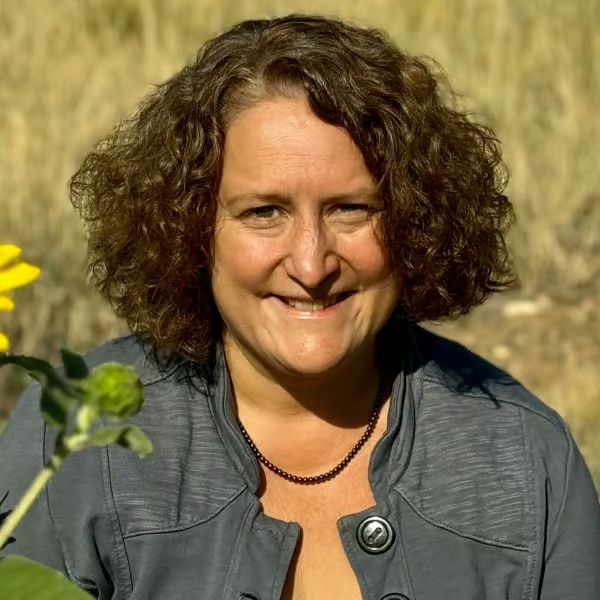
Phaedra C. Pezzullo is an internationally acclaimed researcher and prominent scholar in the area of rhetoric and cultural studies, focusing primarily on environmental and climate justice studies and environmental communication more broadly. She is a Professor and Kleiman Faculty Scholar in the Department of Communication at the University of Colorado Boulder. Her advocacy work, especially with communities that face the greatest burdens of environmental unsustainability, has been consistent and greatly impacted this field of study. Pezzullo has a robust publication record which includes 10 books to date, two award-winning monographs, one coauthored textbook in four editions, one edited volume, and three co-edited volumes, in addition to 26 peer reviewed journal articles, and 5 reprints. She was the inaugural recipient of the Daniel C. Brouwer Faculty Mentorship Award from NCA’s Rhetoric & Communication Theory Division, in honor of her deep dedication to inclusive mentorship for graduate students. Most remarkably, she also received NCA’s Presidential Service Award in 2009. Given her career-long outstanding accomplishments in the areas of teaching, research, and service, as reflected in her prestigious NCA awards to date, Pezzullo is an ideal recipient for this award.
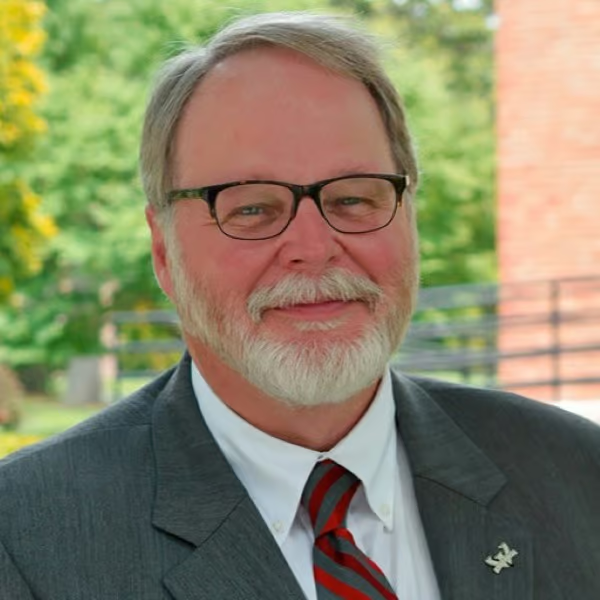
Matthew W. Seeger is a scholar in crisis and risk communication whose work has transformed theory, research and practice for more than four decades. His scholarship broadened the field beyond reputation management to address public health emergencies, natural disasters, environmental contamination, technological failures and organizational renewal. Through 11 books, more than 200 peer-reviewed publications and presentations, and influential models of crisis, renewal and emergency risk communication, he has shaped research and practice worldwide. His collaborations with the CDC and World Health Organization, founding journal editorship, interdisciplinary leadership and mentorship of more than 40 doctoral students exemplify distinguished scholarly impact.
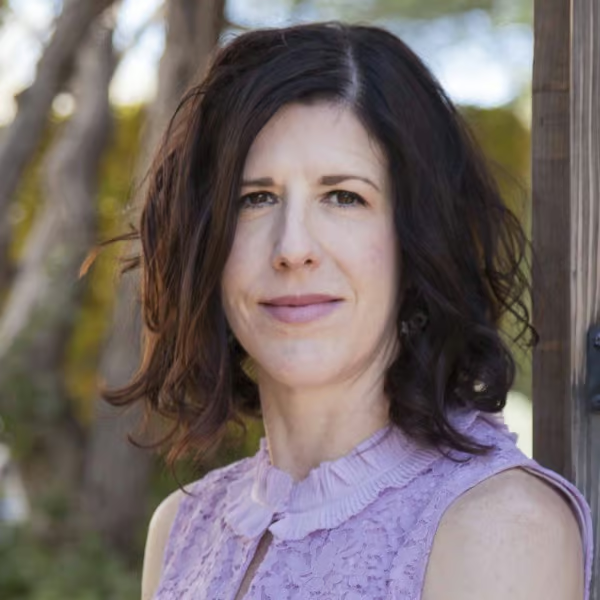
Stacey K. Sowards is a leading transnational critical communication scholar whose groundbreaking work spans international and intercultural, environmental, feminist and Latine communication studies. Across her monograph, edited volumes, and articles and chapters, she has challenged English-language dominance, centered women of color in social movement scholarship, advanced understandings of feminist agency and transformed research on transnational environmental communication. As the first woman of color to edit the Quarterly Journal of Speech, Sowards expanded the journal’s international and racial diversity while amplifying marginalized voices. Her influential scholarship, mentorship and field-shaping editorial leadership embody the highest standards of a Distinguished Scholar.